
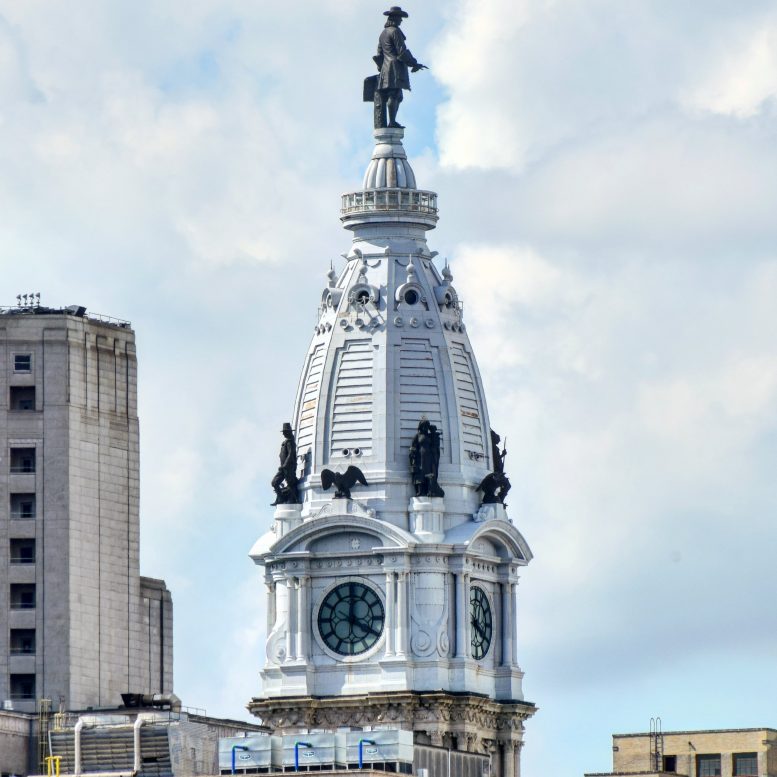
The statue of William Penn has stood at the peak of City Hall in Center City for almost 127 years, rising to a height of 547 feet. The sculpture was created by Alexander Milne Calder, who had also produced the building’s smaller yet still massive bronze statues of eagles, Native Americans, and Quakers above the clock house, as well as over 250 figures casted around the clock tower and nine story building. City Hall was originally known as “Public Buildings” or “City Buildings” while the clock tower was referred as the City Hall tower. The building was designed by John McArthur Jr. and Thomas Ustick Walter, and had completed construction in 1901. Today Philly YIMBY looks at the process of the assembly of the building pinnacle and the statue.
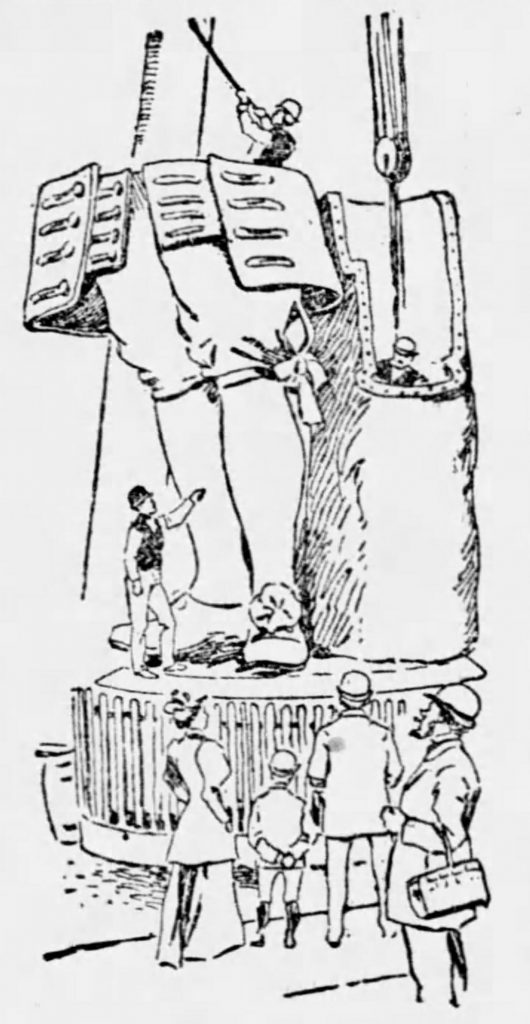
Statue of William Penn disassembly. Image via The Boston Globe
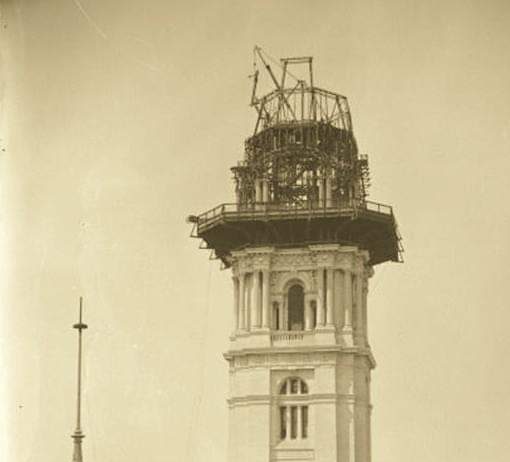
Philadelphia City Hall construction 1894. Photo via phillyhistory.org
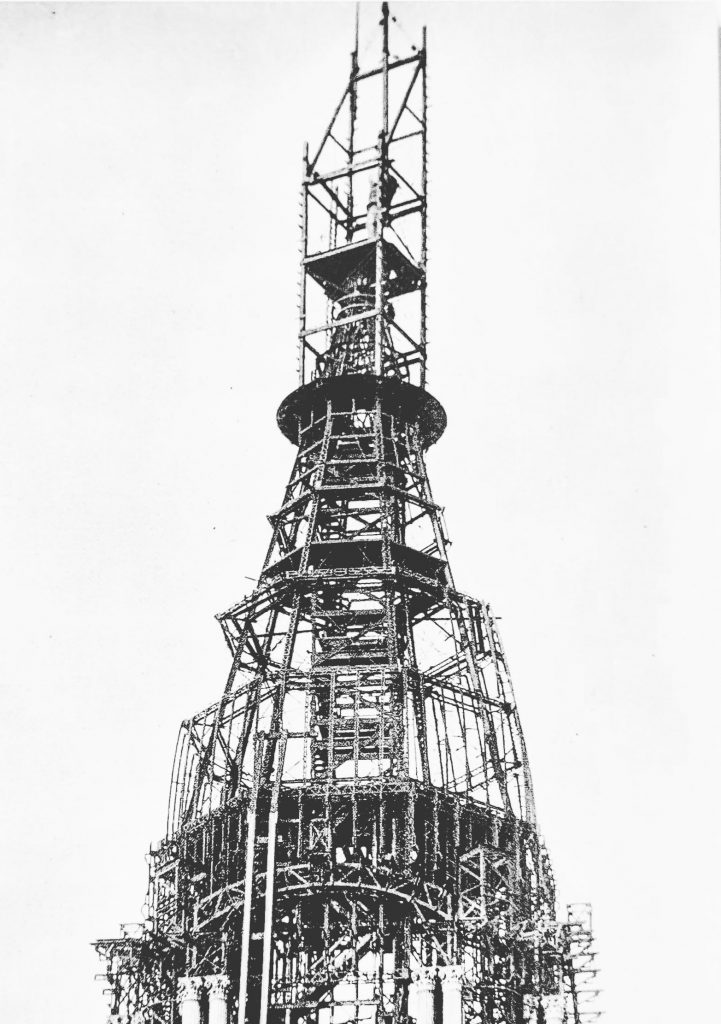
Statue Of William Penn’s right leg on top of City Hall December 1894. Image via phillyhistory.org
The massive structure had started construction in 1871, beginning with tearing up Penn Square that was formerly located at the site. The gigantic space would be transformed over the course of the next few years. The building rose above ground in two years and the Public Buildings topped out in 1882. At the same time, the base of the City Hall tower was under construction. The stone structure of City Hall tower was completed by 1886 and the framing had started in the next few years after the large platform to hold the framing and the sculpture was erected.
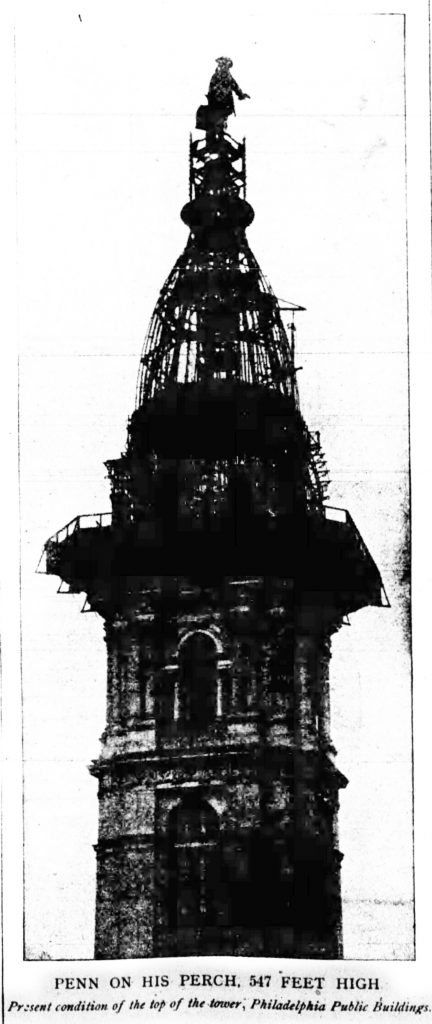
Statue Of William Penn on top of City Hall January 1895. Image via Buffalo Express
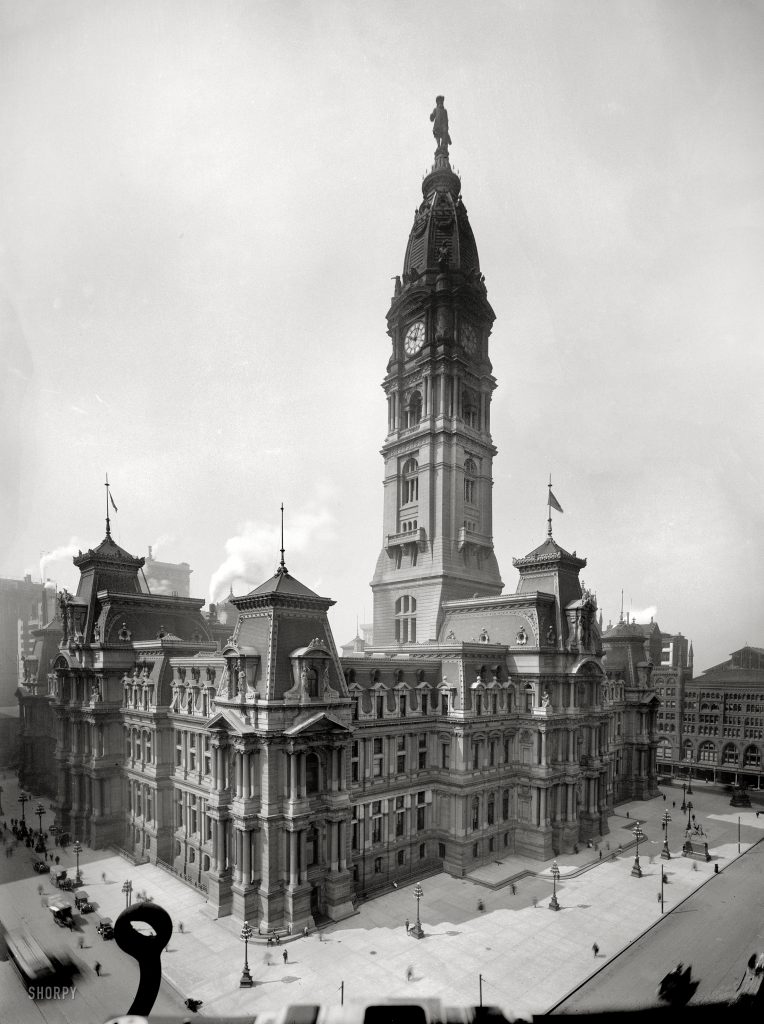
Philadelphia City Hall 1910. Photo via shorpy.com
Casting work for the statue of William Penn had started just a few years before the clock house frame was built atop the stone tower. The statue was sculpted in 1886 and was built and completed in 1892, which was then eventually taken apart in 47 pieces and taken to the courtyard of City Hall to be assembled on the west side of the tower. The statue would be disassembled again at the very end of October 1894. The statue was lifted up in 14 pieces, with the head lifted off of the ground at 10 o’clock on Thanksgiving, November 29, 1894. The head went airborne and was in place 22 minutes after liftoff, with one worker fastening bolts inside to secure the final piece along with thirteen men on the temporary cage surrounding the statue as they were controlling the ropes with the derrick crane lifting. Workers soon opened the top hatch and cheered and waved their hats from the top, with an American flag temporarily placed on the top of the tower for the morning
Subscribe to YIMBY’s daily e-mail

Follow YIMBYgram for real-time photo updates
Like YIMBY on Facebook
Follow YIMBY’s Twitter for the latest in YIMBYnews
Very interesting iteration of the construction of City Hall. The 1910 picture of City hall makes me thinking about the planned underground digging for the MFL and ultimately the BSS and the trolley loop around City Hall.
548 feet is the height of City Hall, not 547.
The statue of William Penn is 37 feet tall.
When I was a youngster way back in the 1970’s, I used to visit the Free Library and learn all about many of the great cities (encyclopedias) because personal computers and the Internet wasn’t commercially available yet.
Back as a kid, I knew the height of City Hall and allot more! 😉
My Great Great Grandfather Giavonni Casani worked for Alexander Calder and was the one who cast the model for the statue. The model had been in the family until a great great aunt gave it away. I often wonder if the model at the Art Museum could be that model. Originally there were 2 models.
Hi Jane,
Sitting here with my 91-year old mom, the great granddaughter of Giavonni Casani. We have heard the same, that Giavonni Casani was the original caster for the William Penn statue on top of City Hall.
Claire Woodsum
I will be 78 years old in a few weeks. I grew up near the Delaware River in Kensington, Pa., which has been nicknamed Fishtown. My brother and I would often walk to Penn treaty Park and sit right where William Penn signed the peace treaty. We could also see in the distance the William Penn statue which was such a delightful ongoing experience in my childhood… I so loved going to center City with my mother and walking right up to City Hall and raising my head to see the massive statue… The Statue of William Penn is such a magnificent work of art and I am so grateful to have grown up in such a historical location. My memories become more vivid and more meaningful every single day. Currently I am on an independent study of William Penn and his beliefs that were so admirable.
Please feel free to share more about William Penn and what you admire about his beliefs. I’m genuinely intrigued.
My grandfather rode a bicycle around the rim of Penn’s hat…before it was raised to the heights. True story!!!
Would anyone happen to know the year that William Penn’s statue was on the ground in the 1920’s?
To whom it may concern:
I grew up in Conshohocken and you can see downtown Philadelphia from one of the summits in Conshohocken. It’s all developments now, but it was where the United Nations building was going to go before the Rockefellers scratched it. Probably just as well. Anyway, my question is why why is the garland missing on the tower? I did hear a tail that one of them blew off in the 1920s so they decided to take them all down and they lost them apparently. But why can’t they be fabricated in aluminum and then simonized (sp) to hold up for years to the elements? Also, the color of the clock box is truly a battleship GREY. Why? i’m aware that it’s copper underneath just like the Statue of Liberty….. that is underneath that gray paint. Why can’t the gray be toned to match the stonework so at least there’s no distraction in the color differentiation. The other way to do it is to do a very degree that gives the various similitude of green copper, and that can also be done in a paint that is baked on. I gather that would be harder to maintain. But in the meantime, why can’t it just be the same warm sandstone tone that the building is? Is it laziness or is there some intention to it? We all know how cities and all music municipalities can screw up the smallest things in their clog of disarray and also new people coming on board and not knowing what to do because there’s no historic continuity. I forget the name of it an institutional memory perhaps(?). Either way it’s very distracting and for something so beautiful it should all be one unit. For as much as Philadelphia City Hall cost, they could’ve at least used copper on all the roof fretwork. Instead, they used cast-iron. Castor has a natural propensity to degrade in as little as vapor rust and it’s gotta be painted both back in front with a red lead paint the sort of paint you use on a ship hull.
I certainly don’t expect an answer because this is a very old article now. But I do hope someone sees my comment and response and responses intelligently not just some short quip. The restoration that was done is truly magnificent and the photography is incredible and I love how the buildings lit up at night with LEDs that other lighting we had to put up with that for years. It was so bad and that mercury vapor lighting at night time. It was just worthless now what would be fun is to do the strong lights as in the old photograph Where the lights come down like a Christmas tre. That’s a great look in the photograph at least and the old-fashioned spotlights that were on it and in another old photograph would be cool too. An interesting note here Mercury vapor lighting was invented in the early 1900s but they decided not to use it because it was so ugly. And they would be correct.
Sincerely, David Jonathan Bell Bell