
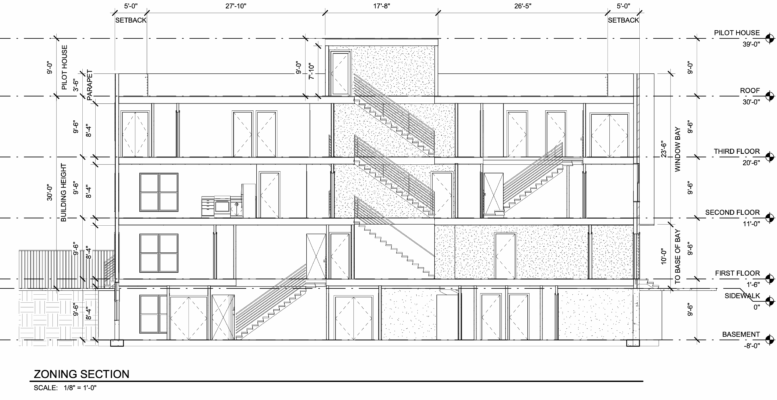
Construction permits have been issued for a three-story, four-unit residential development at 923 North 47th Street in Mill Creek, West Philadelphia. Plato Studio is the architect and Yona Construction is the contractor. The property owner is listed as 923 N 47th St LLC.
Permit records list a total construction cost of $500,000, which includes $400,000 for general construction and $100,000 for excavation work.

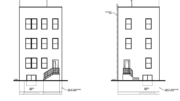
923 North 47th Street Plan via Plato Studio
The approved scope of work calls for the erection of a building with a basement and a roof deck and roof deck access structure, set behind a parapet. Permit documentation specifies Type VA construction. The scope also requires a covered walkway or sidewalk closure within the building facade.
Zoning documentation places the property within the RM-1 zoning district, designed for R-2 occupancy, where multi-family use is permitted. The lot measures 18 feet wide and 100 feet deep, with a total area of 1,800 square feet. The project site extends to May Street at the rear. Plans show a building footprint of 1,450 square feet, a rear yard depth of 18 feet (where nine feet is required), and a proposed building height of 30 feet, well below the 38-foot maximum. The building will feature elements such as a window well and a bay window.
The site sits near the Philadelphia Zoo. A construction timeline has not been announced.
Subscribe to YIMBY’s daily e-mail

Follow YIMBYgram for real-time photo updates
Like YIMBY on Facebook
Follow YIMBY’s Twitter for the latest in YIMBYnews
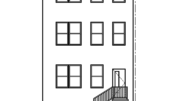
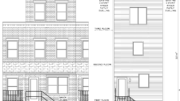
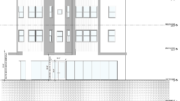
“Zoning documentation places the property within the RM-1 zoning district…” Recall that “RM” refers to “Residential Multi-Family Districts
Moderate- to high-density, multi-unit residential buildings”.
RM-1 to RM-4 designation determines allowable land use, size, and intensity of use. RM-1 is the smallest, least intense of the multifamily codes.
RM-1:
Min. Lot Width 16 ft.
Min. Lot Area 1,440 sq. ft.
Max. Occupied Area Intermediate 75%; Corner 80%.
Min. Front Setback Based on adjacent.
Min. Side Yard Width 5’ to 12’ based on number of families.
Min. Rear Yard Depth 9 ft.
Max. Height /FAR (Floor Area Ratio) 38 ft.
Dwelling Unit Density: A minimum 360 sq. ft. of lot area is required per dwelling unit for the first 1,440 sq. ft. of lot area. A minimum of 480 sq. ft. of lot area is required per dwelling unit for the lot area in excess of 1,440 sq. ft.
Other codes are:
RSD, Residential Single-Family Detached Districts
Detached houses on individual lots
RSA, Residential Single-Family Attached Districts
Attached and semi-detached houses on individual lots
RTA, Residential Two-Family Attached District
Two-family, semi-detached houses on individual lots
RMX, Residential Mixed-Use Districts
Residential and mixed- use development, including master plan development
CA, Auto-Oriented Commercial Districts
A range of uses, often in the form of shopping centers and other destination-oriented uses
CMX (1, 2, 2.5), Neighborhood Commercial Mixed-Use Districts
Neighborhood-serving retail and service uses, including pedestrian friendly retail commercial corridors
CMX (3, 4), Community Commercial Mixed-Use Districts
Community- and region-serving mixed use development, including retail and service uses
CMX (5), Center City Commercial Mixed-Use District
Mixed-use development in the central core area of Center City
IRMX, Industrial Residential Mixed-Use District
A mix of low-impact industrial, artisan industrial, residential, and neighborhood commercial uses
ICMX, Industrial Commercial Mixed-Use District
Commercial and low-impact industrial uses
I-1, Light Industrial District
Low-impact uses including light industrial, fabrication, offices, and research and development
I-2, Medium Industrial District
Light/moderate impact industrial uses including manufacturing, processing, and distribution
I-3, Heavy Industrial District
Intensive, high-impact uses, including extractive industries and petroleum processing and storage
I-P, Port Industrial District
Marine-related industrial uses such as docks, wharves, piers, and transit sheds
SP-INS, Institutional (Special Purpose) District
Institutional uses in accordance with an approved master plan
SP-CIV, Institutional (Special Purpose) District
Development and preservation of public-serving institutions and a customary and complementary mix of uses
SP-PO, Parks and Open Space (Special Purpose) District
Preserve and protect lands set aside for park and open space use
SP-ENT, Entertainment (Special Purpose) District
Development of major entertainment facilities in accordance with an approved master plan
SP-STA, Sports Stadium (Special Purpose) District
Large scale specialized sporting facilities and associated large capacity automobile parking areas
SP-AIR, Airport (Special Purpose) District
Airport uses and complementary mix of uses, while minimizing impacts on surrounding areas
“…designed for R-2 occupancy, where multi-family use is permitted.”
In Philadelphia, R-2 Occupancy refers to residential buildings with more than two dwelling units, like apartment houses, where residents stay long-term, requiring specific building/fire code compliance for multi-family safety (sprinklers, fire-rated separations) and often falling under zoning like RM-2 (Moderate-to-High Density Residential) or RM-1, as in this project. It covers buildings like apartment buildings and dorms, contrasting with R-3 (single/two-family) or R-1 (hotels), and is governed by International Building Code (IBC) standards adapted by Philly.
Key Characteristics of R-2:
** Type of Building: Apartment buildings, dormitories, convents, and non-transient boarding houses.
** Occupants: Permanent residents.
** Density: Moderate to high-density multi-unit housing.
** Zoning Connection: Often found in RM-2 (Residential Multi-Family) zoning districts, which allow for such development.
Building & Fire Code Implications:
** Fire Safety: Strict requirements for fire-rated walls/floors, sprinkler systems (especially in high-rises or for certain areas like basements/trash chutes), and fire alarms.
** Vertical Openings: Specific rules for enclosing stairwells and shafts.
** Certificate of Occupancy (CO): A CO is needed for R-2 properties, and changes (like adding units) require compliance with code, notes the City of Philadelphia.
In simple terms, if you live in an apartment building or a similar structure with multiple units in the city, you’re likely in an R-2 occupancy, meaning it’s built and regulated for multi-family living, distinct from a single or two family home (R-3).
“Permit documentation specifies Type VA construction.”
International Building Code Fire Resistivity:
** Type I (Non-Combustible Fire-Resistive Construction) – Examples include concrete columns, beams and floors; this type of construction has high assembly fire resistivity.
** Type II (Non-combustible) – Examples included steel columns, beams and deck/floors.
** Type III (“Hybrid” Non-Combustible / Combustible) – Examples include concrete tilt-up construction with wood glulam (subdiaphragm) roof.
** Type IV (“Heavy Timber”) – Examples include 6×10 wood beams / 8×8 wood columns / cross-laminated timbers.
** Type V (Wood Frame Construction) – Examples include wood or metal stud construction; this type of construction has low assembly fire resistivity.
Type VA construction refers to a classification for wood-framed structures where structural elements, exterior walls, and floors/roofs have a 1-hour fire-resistance rating, making it a “protected” wood-frame type, often used in apartments, while Type VB has little to no fire protection, and it’s the least restrictive type.